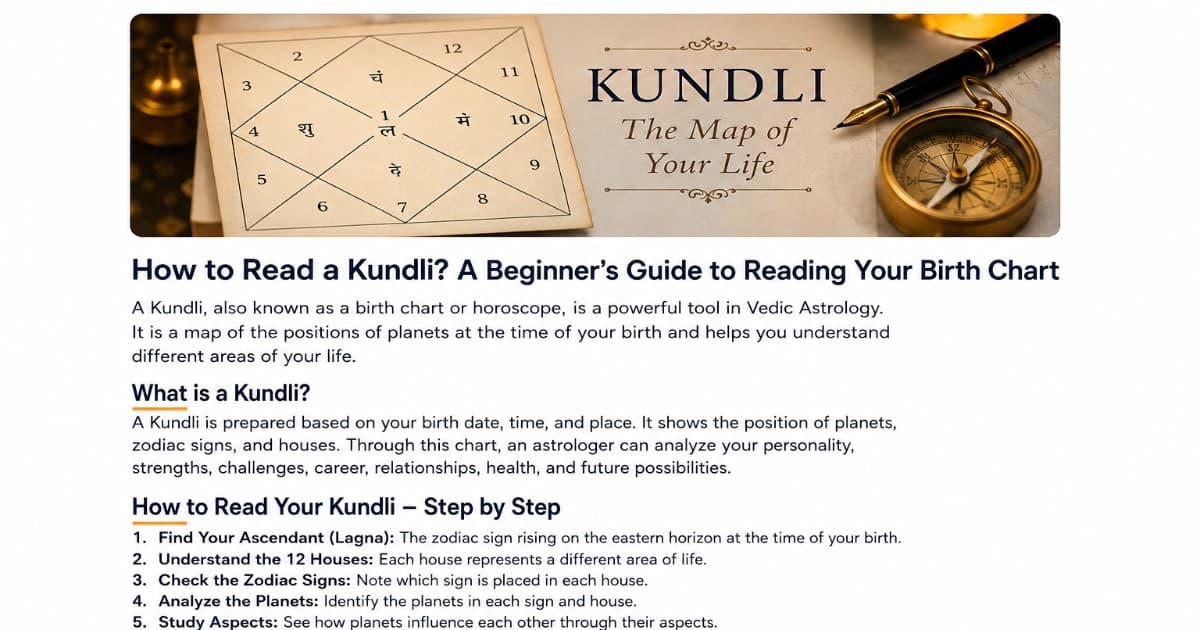
How to Read a Kundli? A Simple Guide to Understanding Your Birth Chart
10 August 2026 · Astro Guru Bindesh
How to Read a Kundli? A Simple Guide to Understanding Your Birth Chart
Discover how to read a Kundli step by step and understand what your 12 houses, planets, zodiac signs, and planetary combinations reveal about love, marriage, career, money, and your life journey.
Introduction
Have you ever opened your Kundli and wondered what all those houses, planets, numbers, and symbols actually mean?
At first glance, a Kundli can look complicated. But once you understand the basic structure, it becomes much easier to understand what your birth chart is trying to show.
In Vedic Astrology, a Kundli is prepared using your date of birth, exact time of birth, and place of birth. It represents the planetary positions at the time of your birth and is traditionally used to understand different areas of life.
Your Kundli may offer insights into your personality, relationships, marriage, career, finances, family life, strengths, challenges, and personal growth.
In this guide, we will explain how to read a Kundli step by step in a simple and easy-to-understand way.
What Is a Kundli?
A Kundli, also known as a Janam Kundali or Birth Chart, is a representation of the planetary positions at the time and place of your birth.
It is based on three important details:
Date of Birth
Exact Time of Birth
Place of Birth
A Kundli contains 12 houses, 12 zodiac signs, planets, house lords, planetary aspects, and various combinations that are traditionally studied in Vedic Astrology.
Each part of the chart has a different meaning. When these elements are studied together, they can provide a broader picture of your life and the different experiences you may encounter.
How to Read a Kundli Step by Step
You don't need to understand everything at once. Start with the basics and gradually learn how each part of the chart connects with the others.
1. Find Your Ascendant or Lagna
The first step in reading a Kundli is identifying your Ascendant, also called Lagna.
The Ascendant is the zodiac sign rising on the eastern horizon at the time of your birth.
It becomes the starting point for understanding your entire birth chart.
Traditionally, the Ascendant is associated with your personality, appearance, confidence, behaviour, and the way you approach life.
Once you know your Lagna, you can begin understanding the placement of the remaining houses.
2. Understand the 12 Houses
The 12 houses are one of the most important parts of a Kundli. Each house represents a different area of life.
1st House – Self & Personality
Represents personality, appearance, confidence, health, and your overall approach to life.
2nd House – Wealth & Family
Connected with savings, family, speech, food habits, values, and accumulated wealth.
3rd House – Courage & Communication
Associated with courage, communication, skills, younger siblings, efforts, and short journeys.
4th House – Home & Emotional Peace
Represents home, mother, property, vehicles, comfort, education, and emotional happiness.
5th House – Love, Creativity & Children
Connected with romance, creativity, intelligence, education, children, and personal interests.
6th House – Challenges & Competition
Associated with work, competition, debts, obstacles, service, and the ability to overcome difficulties.
7th House – Marriage & Partnerships
One of the most important houses for relationships, marriage, partnerships, and business associations.
8th House – Transformation & Sudden Changes
Traditionally connected with transformation, secrets, shared resources, sudden events, and deeper experiences.
9th House – Luck & Higher Knowledge
Associated with fortune, spirituality, higher education, beliefs, long-distance travel, and guidance.
10th House – Career & Profession
Represents career, profession, reputation, responsibilities, achievements, and public image.
11th House – Income & Gains
Connected with income, financial gains, friendships, networks, fulfilment of desires, and opportunities.
12th House – Expenses & Spiritual Growth
Associated with expenses, foreign connections, isolation, spirituality, retreat, and letting go.
Why Is the 7th House Important for Love and Marriage?
If you are interested in love or marriage, the 7th house deserves special attention.
The 7th house is traditionally associated with marriage, long-term relationships, partnerships, and the nature of one-to-one connections.
However, an experienced astrologer does not judge marriage simply by looking at the 7th house.
Other factors may also be considered, such as:
The 7th house lord
Venus
Jupiter
The Moon
Planetary aspects
Navamsa chart
Relevant Dashas
Major planetary transits
This is why a complete Kundli analysis can be much more meaningful than a simple zodiac-sign prediction.
3. Identify the Zodiac Signs
Once you understand the houses, the next step is to identify the zodiac signs placed in them.
The 12 zodiac signs are:
Aries • Taurus • Gemini • Cancer • Leo • Virgo • Libra • Scorpio • Sagittarius • Capricorn • Aquarius • Pisces
Each zodiac sign has its own qualities and planetary ruler.
The sign placed in a particular house adds another layer of meaning to that area of life.
For example, the same 7th house can produce a different interpretation depending on which zodiac sign occupies it and which planet rules that sign.
4. Locate the Planets in Your Kundli
The next step is to see which planets are placed in which houses and zodiac signs.
In Vedic Astrology, the commonly studied planetary influences include:
Sun, Moon, Mars, Mercury, Jupiter, Venus, Saturn, Rahu, and Ketu.
Each planet represents different qualities and areas of life.
Sun – Confidence, identity, authority and leadership
Moon – Mind, emotions, comfort and sensitivity
Mars – Energy, courage, action and determination
Mercury – Communication, learning, intelligence and analytical thinking
Jupiter – Wisdom, knowledge, growth and guidance
Venus – Love, relationships, beauty, comforts and attraction
Saturn – Discipline, responsibility, patience and long-term lessons
Rahu – Ambition, desire, unconventional experiences and material attraction
Ketu – Detachment, spirituality, introspection and transformation
The meaning of a planet can change considerably depending on its sign, house, strength, aspects, and relationship with other planets.
5. Check the House Lords
This is where Kundli reading becomes more detailed.
Every house is ruled by a particular planet according to the zodiac sign occupying that house.
The astrologer then studies where that house lord is placed and how strong or supported it is.
For example, when studying marriage, the 7th house lord becomes an important factor.
For career, the 10th house and its lord receive particular attention.
For finances, the 2nd and 11th houses and their lords may be examined along with other relevant factors.
This helps create a more complete interpretation instead of relying on one placement.
6. Understand Planetary Aspects
Planets in a Kundli can influence other planets and houses through their aspects.
These planetary influences are an important part of Vedic Astrology.
A supportive influence may traditionally indicate ease, opportunities, or assistance, while a challenging influence may indicate pressure, delays, responsibilities, or lessons.
But one planetary aspect should never be viewed in isolation.
The complete chart should always be considered before reaching a conclusion.
7. Look for Yogas and Important Planetary Combinations
Another fascinating part of Kundli analysis is the study of Yogas and planetary combinations.
Certain combinations are traditionally associated with themes such as:
Career growth
Wealth and financial opportunities
Education
Leadership
Marriage
Creativity
Spiritual development
There are also combinations traditionally described as Doshas.
However, there is no need to become worried simply because someone tells you that a particular Dosha appears in your Kundli.
Its strength, cancellation factors, planetary support, and the overall chart should be considered before making any interpretation.
How to Read a Kundli for Career
If your main concern is career, several factors are traditionally examined together.
These may include:
10th House • 10th House Lord • 6th House • 2nd House • 11th House • Sun • Saturn • Jupiter
The 10th house is particularly important because it is associated with profession, responsibilities, reputation, achievements, and public life.
But career analysis should not be based on the 10th house alone.
The condition of its lord, planetary aspects, other relevant houses, and planetary periods can all add important details.
How to Read a Kundli for Money and Financial Growth
Financial questions are another common reason people seek Kundli guidance.
The 2nd house is traditionally associated with savings, accumulated wealth, family resources, speech, and values.
The 11th house is associated with income, gains, networks, opportunities, and fulfilment of desires.
Other houses and planets may also become important depending on the individual chart.
Rather than asking, “Will I become rich?” a more useful approach is to study the complete financial picture of the Kundli.
How to Read a Kundli for Love and Marriage
Love and marriage are perhaps the areas that create the most curiosity.
A relationship-focused Kundli analysis may consider:
5th House – Love, romance and attraction
7th House – Marriage and partnership
Venus – Love, attraction and relationship harmony
Jupiter – Wisdom, guidance and traditional marital significations
Moon – Emotional connection and sensitivity
7th House Lord – Condition and placement of the marriage lord
Navamsa Chart – Deeper relationship and marriage analysis
Dashas and Transits – Timing of important developments
This is why simply checking your Sun sign is not enough to understand your complete relationship picture.
What Is the Navamsa Chart?
The Navamsa Chart, also known as the D9 chart, is an important divisional chart in Vedic Astrology.
It is traditionally given special importance when studying marriage, relationships, planetary strength, and deeper aspects of life.
For relationship-related questions, astrologers may study the main birth chart together with the Navamsa chart to develop a more detailed interpretation.
Why Are Dashas and Transits Important?
A birth chart represents the planetary picture at the time of birth, but astrology also focuses on timing.
This is where planetary periods, commonly known as Dashas, and major planetary transits become important.
They are traditionally used to understand when particular planetary themes may become more active.
For example, a person may have strong career combinations in their birth chart, but the timing of career changes, opportunities, or challenges may be studied through Dashas and transits.
Common Mistakes People Make While Reading a Kundli
If you are learning astrology, avoid these common mistakes:
1. Judging an entire life from one planet.
2. Assuming that one difficult placement automatically means something bad will happen.
3. Ignoring the house lord.
4. Forgetting planetary aspects.
5. Looking only at the Sun sign.
6. Ignoring planetary strength and dignity.
7. Making marriage predictions without studying the relevant relationship factors.
8. Treating every Yoga or Dosha as an absolute prediction.
A Kundli is a complete picture. The real meaning often comes from how different parts of the chart work together.
Can You Read Your Own Kundli?
Yes, you can certainly learn the basics of Kundli reading yourself.
You can generate a birth chart using your birth details and begin by identifying your Ascendant, houses, signs, and planets.
But there is an important difference between generating a Kundli and actually interpreting one.
A complete interpretation may involve house lords, planetary strength, aspects, Yogas, Dashas, transits, and divisional charts.
That is why many people prefer to discuss their chart with an astrologer when they have an important personal question.
When Should You Consider a Detailed Kundli Analysis?
You may consider a personalized consultation if you are looking for clarity about questions such as:
“Why am I experiencing repeated delays in marriage?”
“Why do my relationships keep becoming complicated?”
“Which career direction may be more suitable for me?”
“Why am I facing repeated professional obstacles?”
“What does my Kundli indicate about my financial opportunities?”
“Which planetary period am I currently going through?”
A personalized reading allows the discussion to focus on your birth chart and your specific question, rather than giving you a general prediction.
Final Thoughts
A Kundli may look complicated when you see it for the first time, but its basic structure is actually quite systematic.
Start with your Ascendant, understand the 12 houses, identify the zodiac signs, locate the planets, study the house lords and planetary aspects, and then explore Yogas, Dashas, transits, and divisional charts.
Most importantly, don't judge an entire life from a single planetary placement.
Every Kundli is different, and the real interpretation comes from understanding how the different parts of the chart connect with one another.
If you have been thinking about your love life, marriage, career, finances, or future direction, your Kundli can be explored in a much more personalized way.
Want to Understand Your Kundli Better?
Sometimes, one question keeps running through your mind:
“Why is this happening in my life?”
A personalized Kundli consultation can help you explore that question through your own birth chart.
At Astro Guru Bindesh, you can get personalized guidance through:
Vedic Astrology
Kundli Analysis
Tarot Reading
Palm Reading
Start with your most important question and understand what your chart may be indicating.
✨ Book Your Personal Consultation Today
Astrology is a traditional belief system intended for guidance and personal reflection. It should not replace professional medical, legal, financial, or other qualified advice.